Sacred Ways © 2026
What to Expect on a Huachuma Pilgrimage in Peru
A practical and spiritual guide for the serious seeker
A Huachuma pilgrimage in Peru is unlike any retreat you have encountered before. It is not a weekend workshop or a passive experience — it is a sustained encounter with the sacred, conducted across ancient ceremonial landscapes that have held this practice for over 4,000 years. For the serious seeker, it represents one of the most profound opportunities for healing, self-knowledge, and spiritual transformation available anywhere in the world.
Huachuma, known botanically as Trichocereus pachanoi and colloquially as San Pedro, is a columnar cactus native to the Andes of Peru, Ecuador, and Bolivia. It has been used in ceremonial contexts since at least 2,000 BCE, with archaeological evidence from the Chavín culture suggesting its ritual use dates back even further. Unlike many plant medicines that have only recently entered Western awareness, Huachuma carries an unbroken lineage of ceremonial practice that connects modern participants to one of the oldest spiritual traditions on Earth.
The Nature of the Experience
Huachuma is often described as a heart-opening medicine. Where other plant medicines can be introspective and visionary in a way that feels internal and sometimes turbulent, Huachuma tends to expand outward — heightening sensory perception, deepening emotional presence, and creating a profound sense of connection to the natural world, to other people, and to something larger than the individual self. Participants frequently describe an experience of clarity rather than confusion, of love rather than fear.
A ceremony typically lasts between ten and fourteen hours. During that time, participants move through phases of increasing depth — from an initial opening of the senses, through a middle period of emotional and perceptual intensity, to a gradual return that often carries a quality of deep peace and integration. The experience is strongly shaped by the ceremonial container: the land, the lineage of the facilitator, the intention held by the group, and the sacred sites visited.
The Sacred Andes as Ceremonial Landscape
One of the defining features of a genuine Huachuma pilgrimage is that the ceremony does not happen in a room. It happens in the landscape itself. The Andes of northern Peru — particularly the region around Trujillo, the Moche Valley, and the highland sites of the Chavín culture — are among the most ceremonially charged landscapes on Earth. These are places where Huachuma has been worked for millennia, and the land itself carries that history.
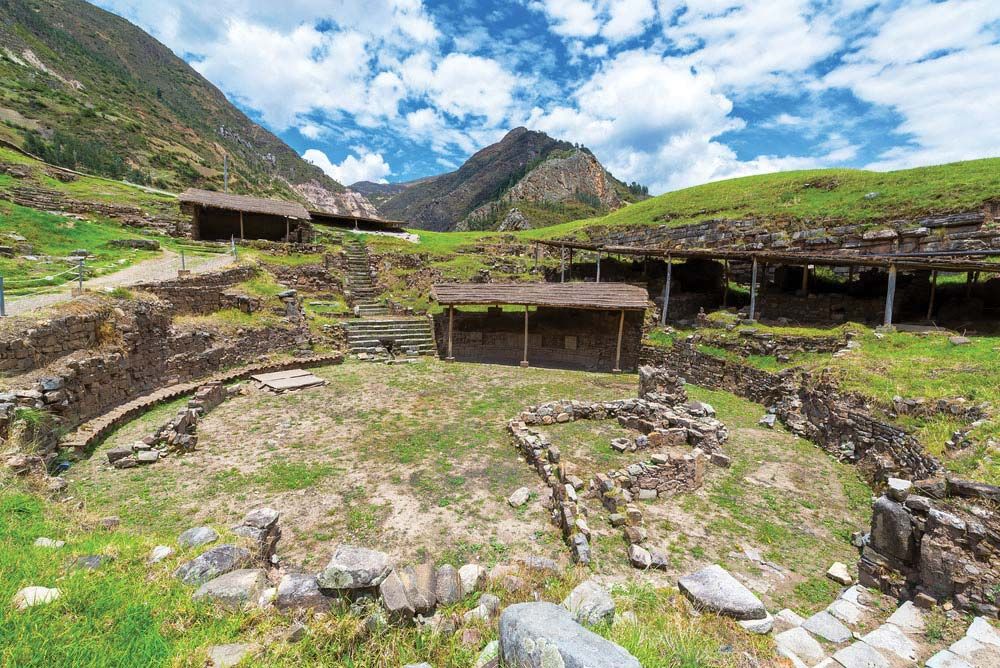
A well-designed pilgrimage will take participants to sites including the Huaca de la Luna, the great adobe temple complex of the Moche civilisation; the coastal desert huacas where the relationship between the sea, the sky, and the earth is palpable; and potentially to Chavín de Huántar itself, the ancient ceremonial centre where the Chavín Huachuma mesa tradition originated. Each site adds a layer of depth to the ceremonial experience that simply cannot be replicated in a retreat centre.
Preparation: What You Need to Do Before You Arrive
Preparation for a Huachuma pilgrimage is not merely logistical — it is itself part of the ceremonial process. Most experienced facilitators will ask participants to observe a dietary protocol in the weeks before arrival. This typically involves reducing or eliminating alcohol, processed foods, recreational drugs, and in some cases animal products. The purpose is not asceticism for its own sake but rather to arrive at the ceremony with a body and nervous system that is as clear and receptive as possible.
Equally important is psychological preparation. Participants are encouraged to identify their intentions clearly — not as demands placed on the medicine, but as honest statements of what they are seeking. Common intentions include healing from grief or trauma, clarity around a major life decision, reconnection with a sense of purpose, or simply the desire to experience something genuinely sacred. Journaling, meditation, and time in nature in the weeks before departure all support this process.
Physically, a pilgrimage in the Andes involves walking on uneven terrain, sometimes at altitude, and spending extended periods outdoors in variable weather. Participants should be in reasonable health and should disclose any medical conditions or medications to their facilitator well in advance. Certain medications — particularly SSRIs and MAOIs — can interact with plant medicines, and a responsible facilitator will work with you to navigate this safely.
The Role of the Facilitator
The quality of the facilitator is the single most important variable in a Huachuma pilgrimage. This is not a medicine that can be worked safely or deeply by someone who has simply attended a few ceremonies. A genuine Huachuma facilitator carries years — often decades — of apprenticeship within a specific ceremonial lineage, a deep knowledge of the land and its sacred sites, and the personal integrity to hold space for others in states of profound vulnerability.
The Chavín Huachuma mesa tradition, which forms the ceremonial foundation of the Sacred Ways pilgrimage, is the most sophisticated and ancient of the Andean Huachuma lineages. It predates the Inca by over 2,500 years and is rooted in the ceremonial practices of the Chavín culture, which is recognised as the cradle of Andean civilisation. Working within this lineage means working with a tradition that has been refined and transmitted across an almost incomprehensible span of human history.
Integration: The Work That Continues After You Return
The ceremony itself is only the beginning. What participants consistently report is that the most significant shifts in their lives occur not during the experience but in the weeks and months that follow, as the insights and emotional openings of the ceremony are integrated into daily life. This process — known as integration — is as important as the ceremony itself, and a responsible pilgrimage will include structured support for it.
Integration might look like changes in relationships, career, creative practice, or spiritual life. It might involve processing grief that the ceremony brought to the surface, or acting on a clarity about one's direction that arrived with unusual force. Having a community of fellow pilgrims who shared the experience, as well as access to the facilitating team for follow-up conversations, makes this process significantly more supported and sustainable.
A Huachuma pilgrimage in Peru is a serious undertaking. It asks something real of those who come to it. But for those who are genuinely called, it offers something equally real in return — a direct encounter with the sacred that has the capacity to change not just how you feel, but who you are.
Ready to Begin?
Para El Bien De Todos
Continue Reading